

Luck by Chance

The Coefficient Con (Part One)
November 23, 2022Disaster Owned – The First Stage of Healing
December 14, 2022Luck by Chance

By Satish Sekar © satish Sekar (February 23rd 2018)
Big Talent
Just a few months ago, like many Nigerian boys, Mohamed Nur Mohamed, was playing football with a sock stuffed with cloth on the recently mean streets of Maiduguri, the capital of Borno Province in North-east Nigeria. Now, aged 15 he’s a Super Eagle, touted by some as the next great hope for Nigerian football.
“He’s very young,” Nigeria’s coach at the recent African Nations Championship CHAN said while explaining why he wanted Nur in his squad.
“I’ve seen him playing for his team in the pre-season training in Kano and I take the decision, I need that player, because every time he plays, he makes assists a goal, he scores and he’s very organised, so I say, ‘let’s say I give him a chance,’ and when he plays the Super 6, he did very well, so I think he just needed a push, because he’s a young talent and he can develop better talent, and I feel we have a role to play with young players to be able to put them at this level.
“Better professionals is going to be better for the main team. We don’t want to put too much pressure on him. He’s a young player.
“Just give him ten minutes, fifteen; before you know the world of confidence, the belief is mostly there for assists for others to score.”
Nigeria’s coach, Gernot Rohr is already aware of his potential.
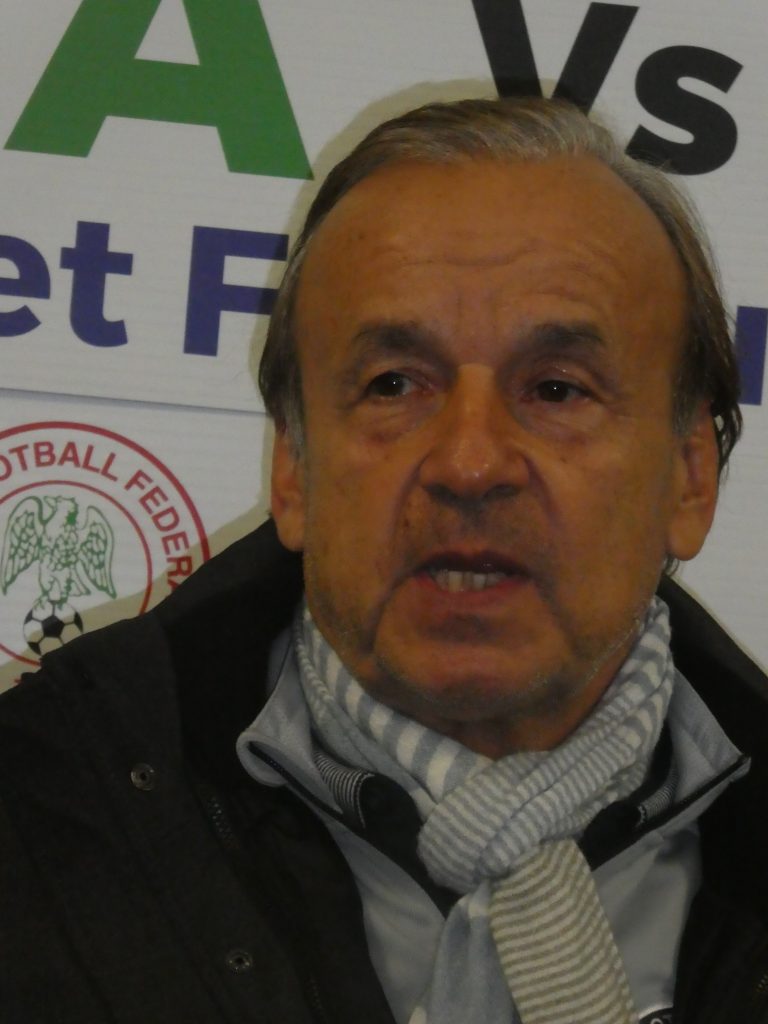
“He’s a big talent,” Rohr said. “He’s a big talent.
“He’s quick. He’s technically already a good player with left and right foot, but he has a lot of work to do. He has to be stronger in the duels.
“He has to be better tactically to know where he has to go, which position, but with 16 [15 actually], fortunately you have space to progress, but the talent is very good and we can hope that one day he will be in the best team of Nigeria.”
Trauma
Football helped Nur to cope with the trauma of losing both parents while still a small child. He doesn’t remember much about his parents, or how they died, but thinks that it was at the hands of the notorious Islamic terrorists Boko Haram.
Maiduguri, comprising of the old city of that name and Yerwa is the capital of Borno. It is actually a city steeped in history, but is now best known for being the heartland of the notorious Islamic terrorists Boko Haram.
“Yes, anybody that was in Maiduguri was the victim of Boko Haram as you know, because they held people [to] ransom for so many years,” Nur said.
But Maiduguri was once famed for a rich history – one that its people are struggling to reclaim in what they hope is the new post-Boko haram era. Just over a century ago it became a military outpost of the British Empire in Nigeria. Prior to that it had been the thriving centre of a millennium old Empire, the Kanem-Bornu, which stretched into neighbouring Chad too. It was influenced by Arabs, which may explain its Islamic roots too, and why Boko Haram base themselves here.
The Empire, which also included territory in Niger, Libya and Cameroon at its height was on the wane at the turn of the 20th century. It was a ripe fruit that was plucked by the British. By 1907 the Kanen-Bornu Empire was history and Maiduguri had a new identity as an integral part of British colonial operations. It also left festering resentment that was later exploited by Boko Haram as its Islamic past was minimised under British rule.
The post-colonial religious divide between Christian and Muslims in Nigeria, especially the north of the country offered a fertile recruiting ground for Boko Haram to exploit. Boko Haram was established in 2002 by the late Mohamed Yusuf to promote his ‘militant’ brand of Islam – one which spread its message at the point of a gun. Nigerian authorities were accused of not taking Boko Haram seriously despite warnings, including from many Muslims, until the notorious attack on police stations in July 2009. This was around the time that Mohamed Nur lost his parents.
Football – his first love
He coped with trauma with football. “I don’t think I have any other thing I love more than football, because I have interest and passion for it,” Nur told me.
“If I was playing football, I don’t have any problem. I don’t even think of anything, just I will just go and enjoy myself.
“That’s why I always used to play, even at that time, I used to go and play. If something wrong happen, I would run. That’s how we used to play.”
Nur’s story could have turned out badly. Thanks to football it hasn’t. Orphaned at a tender age, he dreamed as many do of a different life. Football was the key to that dream – one shared by many young Nigerian boys, but Nur had an advantage. He had talent and he was a gifted left footer, a prized commodity.
“I think I was 13-14 – last two years back,” Nur said. “I used to escape because they normally used to come, kill people, do something at that time.
“At that time they were not divided at the time as now, because now the peace has been restored. The business is coming back now – you can go and do everything, everyday activities in our area now, but before then, at that time, they were very strong and do this and do that.
You can’t even go and do this thing freely, but the intervention of our federal government, our state government, they collaborate together to assist.
Now, if you go to Maiduguri, the news that you will hear now is Boko Haram, you go see people busy doing their everyday activities, you will be surprised. Now if you go to Maiduguri, you will be surprised. The peace has been restored now, because everybody is carrying on their normal everyday activities as they used to do.”
Luck
Nur escaped the clutches of Boko Haram. Some of those he played with were not so fortunate. He can’t remember the boy’s name, but says they were good friends, sharing aspirations of football giving them a new life. It happened for Nur, but not for his friend. That boy, he thinks was called Musa, died young – another victim of Boko Haram. Nur was lucky. He escaped the terrorists – he’s modest about it. He simply got away from them without being captured by them.
“No personally, nothing happens to me like come and take me away, or anything, but they used to come in convoy or come in group to attack place and you run here from here to here,” Nur said. “I experienced this thing so many times.
“I experienced this so much, but thank God, God assist me to escape, because they used to come. When they come they would just open fire on people, soldier, everybody.
“It is those that are lucky – they will escape. Those that are not lucky, sometimes you are still like this they will come and beat you. You don’t know from no-one, but as of now, but later the government intervened.
“The federal government stepped in and everything start to be restored. Everything is looking better now. If you go you will see business is growing everybody. You can go and play, everything.”
Others were not so lucky. Some died, others were held hostage, or forced at gunpoint to join the terrorists. He says he lost friends to both. One boy, he thinks was named Musa – his recollections of names and dates are hazy, but he was a young child when these events happened – was a good friend. They played football and shared dreams. Nur was lucky, Musa wasn’t. He was killed by Boko Haram. Others he played with were taken prisoner and indoctrinated into joining Boko Haram.
Prodigy recognises Prodigy
As Maiduguri’s fortunes began to change so did Nur’s. He was discovered playing street football by a local coach and invited to join the youth set-up of El-Kanemi Warriors – a Maiduguri based team. They are managed by Imama Amakapabo , known as ‘the Magician.’
Amakapabo made history as a youth prodigy. The then 14 year-old was part of Nigeria’s Under-17 World Cup Squad in 1984. They returned from China conquerors of the world. Having once been a prodigious young talent himself, and built a championship winning team from scratch at Enugu Rangers, Amakapabo knows a thing or two about young footballers. He quickly saw something in Nur, but before that Amakapabo established his credentials.
In 2015 he took control of Enugu Rangers, then a team struggling to maintain top flight status. Originally hired temporarily to save the club from relegation after a dismal season under Kelechi Emeteole, Amakapabo fulfilled his mission and was eventually rewarded with the top job on a permanent basis. He recruited the players he wanted and a commitment not to sell them and took his team marauding up the league to the brink of something really special – the Premier League title. Based in Enugu State in the south – east of Nigeria, Amakapabo led the team to their 7th title in 2016.
Amakapabo was then appointed Technical Director and manager of El-Kanemi Warriors. After 8 matches of 2018 season they prop up the league, but just a point adrift from 15th place and out of the relegation places. El Kanemi Warriors have twice won the Nigerian Cup, 1991 and the following year. They were relegated from the top division in 2007, returning five years later, but like the Azeri team Qarabağ, they were made football refugees by violence – in their case the Boko Haram insurgency. In 2014 the Warriors played their ‘home’ matches in Kano before a two-year move to Katsina, which is also a Muslim state in the north of the country.
In 2017 the Warriors returned to the El-Kanemi Stadium in Maiduguri. That October they appointed Amakapabo as their manager. Like Salisu Yusuf, Nigeria’s coach at the recent CHAN, Amakapabo was quickly impressed with Nur. He arranged a match between the feeder (development) team and the first team. Nur showed him qualities he wanted to see and promoted him to the senior team. He was just 14, but Nur says there are others as talented as him in Maidguri. Modestly, he says he just benefited from ‘luck by chance.’
Luck by Chance
“We just go to Kano to play an invitational competition with my team El Kanemi Warriors,” Nur explained, “so it was in that competition when we are playing and it is in December that they are going to play the Super 6 – that is the Super Eagle and the other five clubs of Nigeria.”
They are going to play their Super 6 after that competition, so it was in that competition that we played, the coach [Salisu Yusuf] saw me; they asked me, they are going to see me.
“I never expected, but I had. I always dreamed one day, one time I will either go to the Under-17 or Under-20, but I never expected I would come here [the CHAN] at this time. I have never expected. It is just come luck by chance.”
Had to Have Him
“Oh, for me, it’s the quality of the player,” Salisu explains, “so it’s all about at 15 if you have intelligence and are too talented, you can play, because it’s the quality of the player, not the age.”
Salisu observed the Super 6 closely and Nur impressed. “For me you see he came from a club side and the coach said he came from the academy, so the coach said, ‘let’s take him for this pre-season,’” Salisu explains.
“I’m not the club coach, but I see, and I say let’s try this boy, because I saw three games in Kano and all this pressure, and he surpassed it against the club sides that play on the continent, but the team here won and they will get like Sunday xxx and other strikers playing, so in that time he did very well; he make and score easy goals.”
Taking a Chance
Salisu Yusuf, possessor of one of the most infectious smiles in football, wanted an outside left and got to hear of the precocious young talent. Yusuf, a former midfielder, used to play and manage El-Kanemi Warriors – Nur’s team.
He was part of former Super Eagles coach, Samson Siasia’s set-up before he went on to manage Enyimba and also El-Kanemi Warriors. He also honed his skills under the late Stephen Keshi and Sunday Oliseh. His success at both clubs brought him back into Nigeria’s set-up, this time as the coach of the Africa-based Super Eagles.
The special thing about him is every time he came into a game he creates moments. “Yesterday if you observe [against Rwanda] he had two moments, you understand, so one thing special is he’s very enterprising,” Salisu said. “You cannot say because here and there he cannot play.
“Ronaldo went to the World Cup. He was very young because they wanted to give him the experience, and he developed into a world class striker, so I think it’s the same thing.
“You see a talent and maybe he needs that push to have that much confidence at this young, young age and to become a better, better player tomorrow is good for his career and it is good for his country and the main team”.
Rohr recognises Nur’s potential, but is more cautious. “When you are 16 already in the CHAN team for such a country like Nigeria, where so many players, you can hope to be in 2022 for example in the A team, but he has to work so much. It’s not enough to be already at 16 to have talent. You have to work so very much and he will do it, and we have good coaches working well with him. I think a big part of the work must be done in his club … and permit also to these young players to start sometimes in the Under-20 team, Under-17 and there is no competition for the moment for these young players, so it would be interesting to develop this for our football.”
His Mission
Nur’s ambitions on and off the field are simple. “My Mission?” he asks. “I don’t have any mission.
“As for now in football, I want to always help my country in one way or the other, no matter how it is I will try my best, but that’s my target.
Of the football I want to at least assist when I got something in life that I can assist or help people that are vulnerable, that need the assistance, I will try and assist them to the best of my ability.
“That’s just my target. I don’t have any passion more than this because I have come from nowhere, so I suppose to at least help others.”
And that goes for his team too. “I’m not just always going to score;” he says. I’m going to give assists, help the team to go forward. That’s my target.
“I always want to be a team player, not an individual player, because if you be a team player, you will help your team and you will help your team at the same time, but if you are individual, it is not always you will get it right. That’s just what I understood.”

