

Historic African Football Centenary Looms Large (Part One)

The Lack of Power and Glory (Part Two)
January 3, 2026
Historic African Football Centenary Looms Large (Part Two)
January 11, 2026Historic African Football Centenary Looms Large (Part One)

By Satish Sekar © Satish Sekar (December 31st 2025)
African Football Centenary Approaches
What is the significance of May 1st and May 3rd 2026? It is the 100th anniversary of two historic – iconic even – matches for African football. It was the first edition of the Gossage[1] Cup, but why was it so important? More than 30 years before the Confederation of African Football (CAF) was established (February 1957) and the Council for East and Central Africa Football Associations (CECAFA) was unofficially founded in 1927 – officially in 1973 – Africa’s first international football tournament took place in a now thoroughly dilapidated football ground in Nairobi.
It was the first international match between Kenya and Uganda. It ended in a 1-1 draw. Two days later, there was a replay, so this was a tournament, not just a casual international match. Indeed, it was. The replay ended in a 2-1 victory for Kenya, making them the first ever winners of the Gossage Cup. It was also the first ever tournament in the history of African football – a big deal, you would think, wouldn’t you?
It should be. It marks the centenary of an important sporting event in East African sport.
Sporting Tradition
We know about the rich history of Kenyan athletics, especially in the 3000m Steeplechase, but what we don’t know is that Kenya’s first gold medallist in that event in the Olympic Games, Amos Biwott, started the Kenyan Olympic tradition in that event – Kenyan Athletics’ signature discipline – two years after the 40-year history of the Gossage Cup came to an end.
The Landi Mawe Grounds – The Shame of East African Football
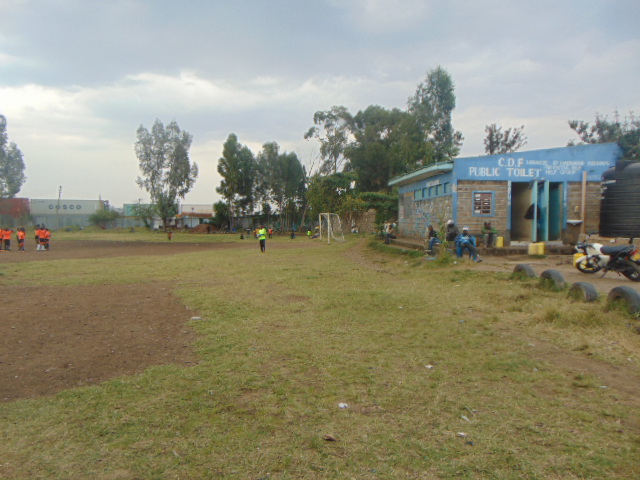
I visited a football ground in Nairobi – the Landi Mawe Grounds, which is in property owned by Kenya Railways. It’s little more than a poorly maintained pitch now. Long gone are the days when it hosted important matches. If you did not know its history, you’d never guess that this was where East African international football – African even – came of age.
The state of the pitch now is shocking – tufts of grass, few and far between, poking through the numerous bald patches. There are no stands worthy of the name. There’s nothing to indicate that this place played a crucial role in East African sporting history. It was the venue for the two matches in May 1926, but there is nothing to commemorate that fact – not even a plaque.
That is a disgrace to African football. The ground deserves to be recognised if restoration is not possible.
Both CECAFA and CAF should commit to celebrating this important anniversary – visit the Landi Mawe Grounds and highlight the role that it played in Africa’s football history.
[1] William Gossage established a family business of soap manufacturers in 1850 in Widnes, Lancashire, England. It later became part of the Unilever Group. This company, William Gossage & Sons Ltd. established the Gossage Cup – well almost. By 1926 William Gossage was long dead – he died in 1877 – and his company Gossage & Sons Ltd. became one of the subsidiaries of Lever Brothers (William Hesketh Lever, later the first Viscount Leverhulme, and James Lever) in 1911.
Despite a scurrilous attack on William Lever’s reputation by Lord Northcliffe over accusations of a Soap Trust, Lever was award substantial libel damages when Northcliffe’s defence capitulated on the first day, after Lever had given evidence.
The first edition of the Gossage Cup took place in Nairobi in 1926. It lasted from 1926 to 1966. It is now known as the CECAFA Cup. Gossage & Sons is credited with having organised football competitions in East Africa – the most important being the Gossage Cup – but Gossage & Sons Ltd. no longer existed as an independent company. By then, 15 years had passed since it became a subsidiary of Lever Brothers and 3 years later Lever Brothers had become Unilever. Although the competition bears Gossage’s name, it could and really should have been known as the Lever Cup.
Lever became a Baronet in 1911, Baron in 1917 and a Viscount 5 years later. His controversial partnership with the Belgian administrators in the Congo to secure a workforce for his plantations there resulted in numerous deaths and brutality – the Congo genocide continued for several years after the Leopold II lost control over ‘his colony’. Leverhulme had much to answer for over his conduct in the Congo. Viscount Leverhulme died in 1925, never seeing the first edition of the football Cup that his company had played such an important role in establishing played.

